
The Chain Ladder, Grand Old Dame of the Drakensberg
Few mountain vistas rival that of the of the iconic Amphitheatre, the most recognisable and dramatically imposing feature of South Africa’s entire Drakensberg range. The great wall of basalt rises over 1000mm from the Thukela (formerly known as Tugela) Valley to a high mountain plateau – a sheer, grey wall that forms a symmetrical amphitheatre extending for five kilometres from Sentinel Peak in the west to the mighty peaks of the Eastern Buttress. The headwaters of the Thukela River flow down from Mont-aux-sources, at 3,282m the highest peak in the northern ‘Berg, before cascading down the Great Escarpment into the gorge below, catching rainbows in their swirling spray. It’s a mesmerising scene. The cliffs are so steep and perilous that the mighty fortress seems impenetrable.
This allure has long attracted mountaineers, climbers and intrepid tourists who gaze in awe at the magnificence of the scene and long to stand on top of the sheer cliffs and spires. In his book ‘Barrier of Spears, Drama of the Drakensberg’ R.O. Pearse records that Colonel Amery, who has a nearby peak named after him having climbed it in 1900 during the Anglo Boer war, was so impressed at the grandeur of the Amphitheatre that he pronounced “there is nothing in the whole of the Canadian Rockies to touch it”. There are few places in the world that come close to this mountain splendour.
In Colonel Amery’s day reaching the top of the escarpment involved a tortuous journey from the foothills, along the Elands River and then up the steep Namahadi pass to the west. Access became easier in the early 1900s when Walter Coventry, a pioneering figure in the development of tourism and conservation in the Northern Drakensberg built a hostel on his farm Goodoo to accommodate hikers and climbers. Coventry was instrumental in improving approach roads and opened a new, more direct hiking route to the top of the Amphitheatre.
The proclamation of the Natal National Park in the upper Thukela Valley in 1916 was a further boost to tourism and conservation. In the late 1920s Otto Zunckel and his son Walter took over the hostel and developed it into the Royal Natal National Park Hotel, one of the jewels of the Drakensberg.
The number of visitors increased and the route via the Mahai Falls and Beacon Gully became the favoured trail to the top of the Amphitheatre and Mont-aux-Sources, which many believed was the highest peak in South Africa. (It’s not, that honour goes to Mafadi, 3,451m, in the Injisuthi area further south)
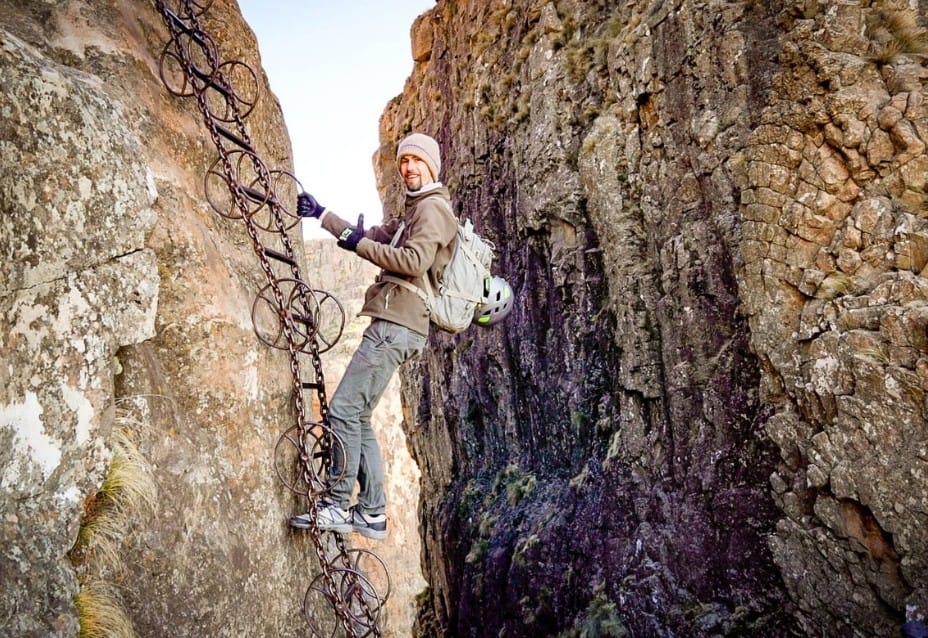
But the installation of chain ladders in 1930 was a game changer. Commissioned by the provincial administration and installed by Otto Zunckel, the 30m-high ladders provided a safer and quicker (if somewhat airy) route to the top of the escarpment for shepherds and adventurers moving between the high ‘Berg and the valleys below.
Now some 8,000 day hikers, overnight campers, mountaineers and trail runners scale the ladders every year and the Amphitheatre Hike, which starts at the Sentinel carpark and ascends the chain ladders, is rated by National Geographic as one of the best trails in the world. From the carpark it’s a gentle climb towards the Sentinel. Once at the base of the precipitous rock face the path swings right and follows the contour path below the Western buttresses until, after a couple of hours you reach the chain ladders.
Even if you’ve seen photos and videos of people climbing them the two parallel sets of double ladders are intimidating, particularly in this wild, remote setting: quite a feat of engineering! On the left are the older, free-swinging ladders while to the right are the newer ‘hooped’ ladders, installed in the 1970s, more sturdy looking and equipped with grab handles. Steel yourself and make your choice. Rising from 2560m at their base to 2987m at the top of the cliff face they’re not for the feint-hearted, particularly at the points where the rungs touch the rock, leaving little space for the toe of your boot to gain purchase!
Paddy Garrett recalls climbing the ladders in the late 50’s when her father, Bill Trauseld, one of the legendary characters of the ‘Berg, was building Thendele Camp in Royal Natal National Park. “My first recollection of climbing the ladders was when I was 12 years old. The rungs that were spaced quite far apart for a child so Dad helped me get a good footing then gave me confidence climb up on my own. It was very scary climbing over the sections that hung away from the surface of the rock, and moving from one ladder to the other was even more hair-raising. Dad taught us to always have three secure points of contact with the ladder before lifting the other hand or a foot: good advice for any mountaineer.”
Intrigued? Intimidated? Fear not, this grand old lady is a treasure; part of the history of the Drakensberg and well-maintained. She has seen triumph and tragedy played out in these lofty mountains, and nearly a century since the installation of the ladders she provides the easiest way, and for unfit hikers probably the only way, to reach the top of the escarpment.
Once at the top take in this magical place, then walk the short distance to the head of the Thukela Falls, where the river plummets into the gorge below. The views are breath-taking – and at 948m the cascade is the highest multi-drop waterfall in the world. That’s a long drop: stay clear of the edge. Once you’ve breathed your fill of this thin mountain air head back to the ladders. Take it easy on the descent. This grand old lady demands respect.
The Drakensberg Via Ferrata
Climbing the Chain Ladders too tame for you? Then the Via Ferrata (Italian for ‘iron way’), on the nearby Beacon Buttress might be right up your street. A modern interpretation of the famous ladders, the Via Ferrata also leads to the top of the Amphitheatre and is sure to get the adrenalin pumping. The ascent of the sheer rock face is aided by staples and cables bolted into the rock so although the protected route is impressive, to say the least, it’s do-able by any reasonably fit hiker. No prior rock climbing or Via Ferrata experience is necessary, but this is definitely not for those with a fear of heights!
Even if you’ve climbed the classic Via Ferrata routes in Italy’s Dolomites or elsewhere, you’ll be blown away. This takes some beating.
 This photograph was taken during the 1986 gathering of the The Explorers Club on the iconic Amphitheatre in the Drakensberg. Members reached the summit via the famous Drakensberg Chain Ladders, ascending to the escarpment for the occasion.
Looking for even more adventure on the Amphitheatre? The Chain Ladder descent also forms part of the exciting Via Ferrata experience offered by Thaba Adventures, combining breathtaking exposure, cables, ladders and spectacular Drakensberg scenery into one unforgettable adventure.
 Review