
Cunene River, Ruacana Falls to the Atlantic Ocean
The scream in my throat muted to a breathless groan. My legs pumped up and down. I couldn’t go up the dune any faster. Sand slipped from under my feet. I was sliding downward to the water’s edge. Metres away a crocodile charged across the green pool. Jagged teeth protruded from its mouth and its wake thrashed white . It came right at me. I just couldn’t move. In stuttered slow motion I could see I was a “goner”. The croc closed in. This time I really screamed …and everything went black.
My heart was still pounding as I reached for the light switch. “Sorry”, I apologised, “just another bad dream”. Anita understood. Matt and Johan had also mentioned persistent nightmares. Why were we being dogged by these images – why now, why here in the suburban comfort of Johannesburg ? Matt reckoned that it was just our sub-conscious minds trying to make sense of the past three weeks – the adventure which had inadvertently taken us into the jaws of death.
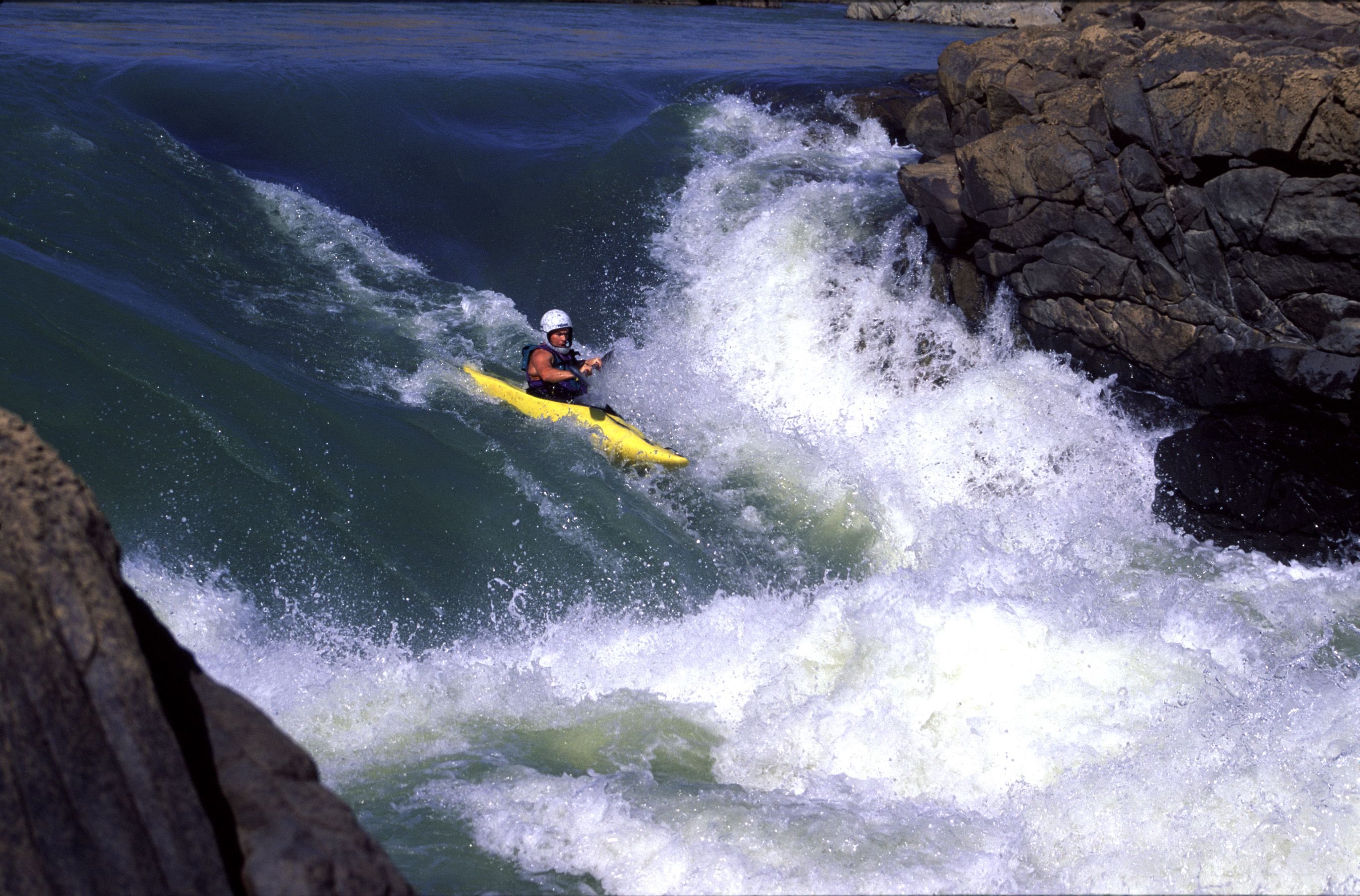
In 1965, Willem van Riet and Gordon Rowe completed a first-ever descent of the Kunene River from Matala in Angola to the Atlantic Ocean on the Skeleton Coast. His account of the journey started :
“ If we had imagined that canoeing down the Kunene River involved blistering heat in a country of utter desolation, hunger, attacks by aggressive crocodiles and such back-breaking labour on the portages, perhaps we would have thought twice about our plans for exploring the lower reaches of this mighty river.”
“ Ditto !” I thought casting my own mind back. The 1200km long Kunene River rises in the Angolan highlands and meanders its way south towards Namibia. At Ruacana it veers westward directly to the Atlantic Ocean and forms the boundary between these two countries. It remains one of Africa’s least explored rivers, partly due to regional conflicts over the past three decades and largely due to its inaccessibility and infamous severity.
Johan Radcliffe, a fellow pioneer of the first source-to-sea descent of the Great Usutu River is squarely to blame for our Kunene Expedition. Having cut his teeth on the Usutu, he was now doggedly focused on this Grade V river with a Grade VI reputation. A river which claimed two lives in an aborted Wits University trip in the early nineties and which barely allowed an air-supported American expedition, guided again by Van Riet to reach the coast a few years later, albeit minus two rafts and some viciously amputated body parts.
“Why do it?”, asked the journalist who on hearing Prof. Van Riet’s reminiscence of the river, was confused as to whether he was to report anadventure or an obituary. “Why !” we later asked ourselves when bravery had clearly crossed the divide with stupidity.
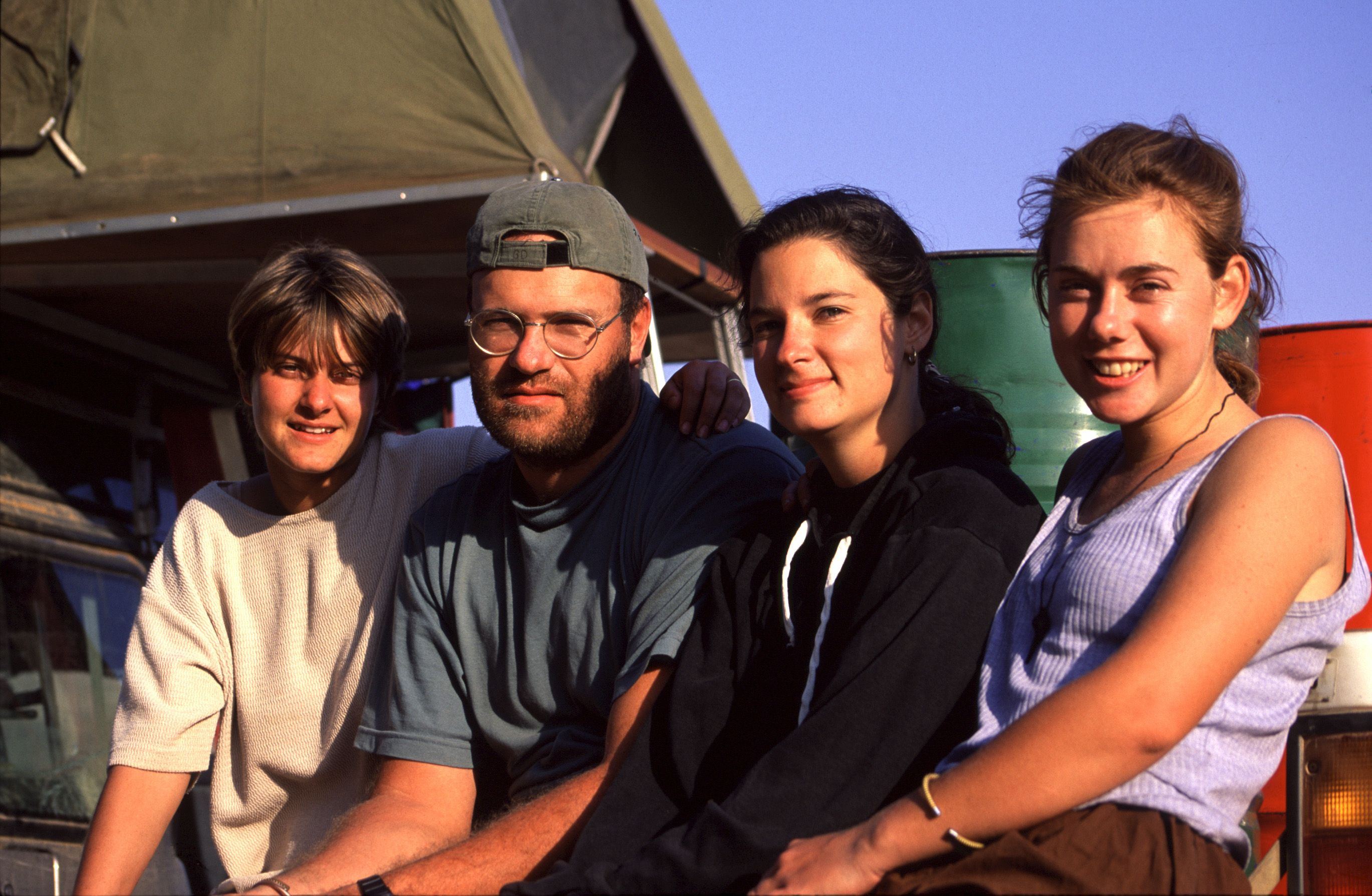
Our rough plan was to travel by river from Ruacana to the sea, an approximately 400km journey supported where possible by 4x4. On departure we hadn’t yet worked out how to return from the inaccessible Kunene Mouth on the Skeleton Coast. Vehicle access was impossible within 50km, so was paddling up or down the coastline to civilisation. Not to be bogged down with details we went anyway. Johan and I were to paddle plastic white-water kayaks and Matthew Pitman, my prospective brother-in-law, was roped in to paddle the supply boat – a 2-man inflatable ARK “Croc” raft. The girl-power crew of Jenny, Anita and Chrizette commandeered the two support vehicles with Graham, the “Jack of All Trades” making up the full team.
On days one to four below Ruacana Falls, we met the vehicles every night alongside the river. The paddling was relaxed, bar some excitement at Ondorusa, a 5m waterfall and at Enyandi, where we missed the main channel and ended up in a grade 5 steep creek. The crocodiles we saw were also few and far between and seemingly mellow.
At Epupa Falls the real adventure started. We parted with our crew, arranging to meet them in anything from four to six days time at Marienfluss, the next place downstream where the river is reliably accessible by vehicle. As we left the spectacular cataract behind us with its many scattered waterfalls and ancient Baobabs, the character of the river changed immediately. Gone were the wide open stretches, palm trees and reed-covered islands, here the river carved a narrow path through razor sharp volcanic rock, bouncing from wall to wall, bubbling, swirling and boiling as it descended seaward.
We descended into the heart of the Baynes and Serra Techamalinde Mountains which towered up to 2000 metre heights above us on either side and the full gravity of our undertaking started to sink in. The prevailing river conditions were arguably worse than those for both previous expeditions which had attempted this stretch. Affected by the hydroelectric scheme at Ruacana, we experienced a weekend shutdown with much lower water levels than other days in the week. Now many more life-threatening obstacles were revealed than were normally cushioned and flooded by higher water levels.
We ran some rapids and portaged others which appeared suicidal. Eight kilometres in eight hours was all we could manage, with back-breaking portages over huge boulders at times. As we paddled on, in our almost indestructible kayaks with full face helmets and the most modern camping gear and high-protein food available , our respect for the 1965 feat undertaken by Van Riet and Rowe grew to total awe. How they survived this in their old open fibreglass canoes must have been close to a miracle.
On day six we passed the tragic point where two University students drowned in 1990. Duncan Longmore was a colleague that I remember from school in Pietermaritzburg. He and his girlfriend paid the ultimate price for pushing the limits – we paused a while in silence and then carried on.
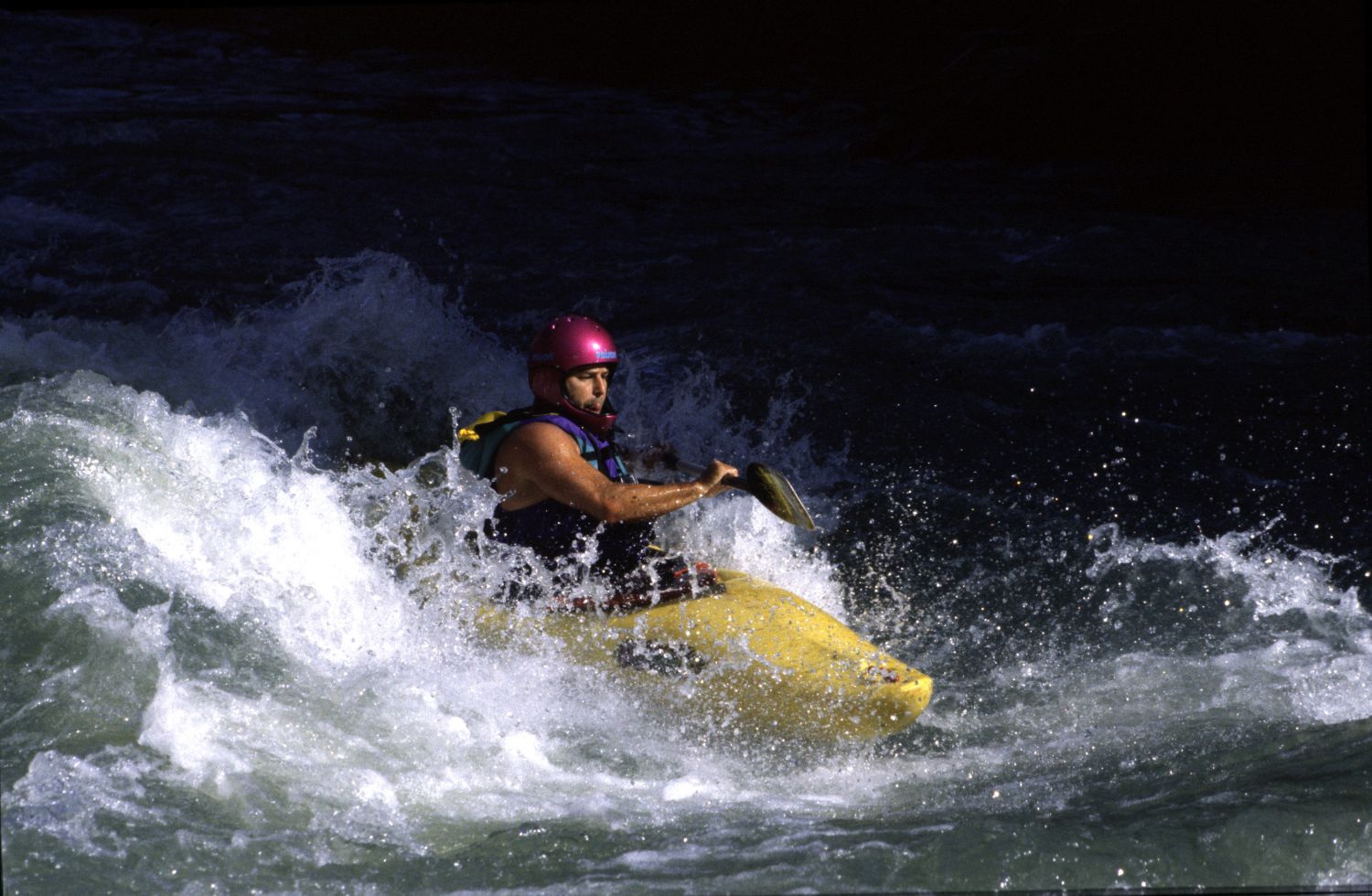
Leaving the Otjiborombongo Valley on day seven we entered the most dauntingly narrow gorge. The entire river squeezed into a gap often only three metres wide. Once committed there was no way of turning back against the current – the only way out was forward. We camped at a small beach deep in this gorge, one of many places only reachable by kayak. The likelihood of being the first ever humans to tread on these secluded places, made our virgin tracks feel like footprints on the moon.
To exit the gorge we were forced to navigate through a series of huge Grade V and VI rapids. There was zero margin for error in most cases and we tackled them successfully with growing confidence and a large dose of luck. What makes the Kunene so lethal is the speed at which it flows unrepentantly onto sharp rocks and the unpredictable manner in which it siphons under boulders and down huge bathplug-like potholes.
Amongst all this we had our first serious croc attack, a cheeky individual which charged directly at us from downstream and which only broke off its attack a metre from us amidst furious paddle-slapping and back-paddling. When we met our crew at the popular Marienfluss 4x4 camp ground, we were the veterans of four further attacks and we babbled with stories of our close escapes.
On entering the Hartmann’s Mountains, the last barrier to the Kunene’s passage to the sea, the landscape got noticeably more unfriendly. It was here in one of many cataract-choked gorges that my luck in particular nearly ran out. Still high on adrenaline from a clean run down the entry rapid, I passed a point of no return while Matt and Johan prudently portaged.
The water started to behave like a pinball in a games machine. It bounced off this wall then that wall, plunging over obstacles and disappearing behind tall boulders. This was not a forgiving river and there was no place to stop. I fought to keep my concentration against images of holding my breath in a submerged watery cavern. I swore loudly at the protruding rocks and boiling foam piles as I passed them. This silly arrogance worked to stay the panic that was freezing my mind and my downstream assault became clinical and precise. Riding the shoulder boils to maximise visibility, using every eddy to slow the descent and surfing right to left with carefully raised rails I fought for survival against the seething water. For 400m the river attempted to break every rule of smooth passage until almost totally disorientated I broke its grip and squeezed into a tiny pothole eddy on the lip of a drop.
The sheer-sided channel disappeared sharply downward. This was the pinball’s exit point – game over. Was this the end for me too ? I tried to climb out, but 20 minutes later realised that I was trapped. The sides were steep and slippery with spray and the small waterfall roared at my back. The lip was scarcely 2 metres wide and plunged into a very narrow gap. It was impossible to see how the water landed, whether in a deadly re-circulating hole, onto a sheer rock or into a pool. Time was running out. The sun had long since dropped below the surrounding mountains – I could not sit here and analyse potential risks any longer.
I charged straight on into the current and ran the fall dead-centre. The brief glimpse of what was below still hadn’t fully registered when I tail-walked out of the foam – into quiet water. Re-united with Johan and Matt we paddled on through an 800m gorge of dark undercut caverns and grotesquely sculptured rocks. The water was now a deep purple reflecting the last light from the twilight sky. The river was hardly two boat lengths across and in places we squeezed through gaps of a metre wide. For brief seconds everything would be almost silent, only the splash of our paddles sounding the depth of the hollow caverns, then an explosion of rock pigeons disturbed from their roosts would rent the air like automatic gun-fire. White-winged bats swirled in their hundreds all around us. “Speilberg would do his nut for a scene like this !” whispered Matt. Almost to cue a black stork and then another and another launched themselves from hidden ledges, soaring out into the night like the pre-historic dinosaur birds.
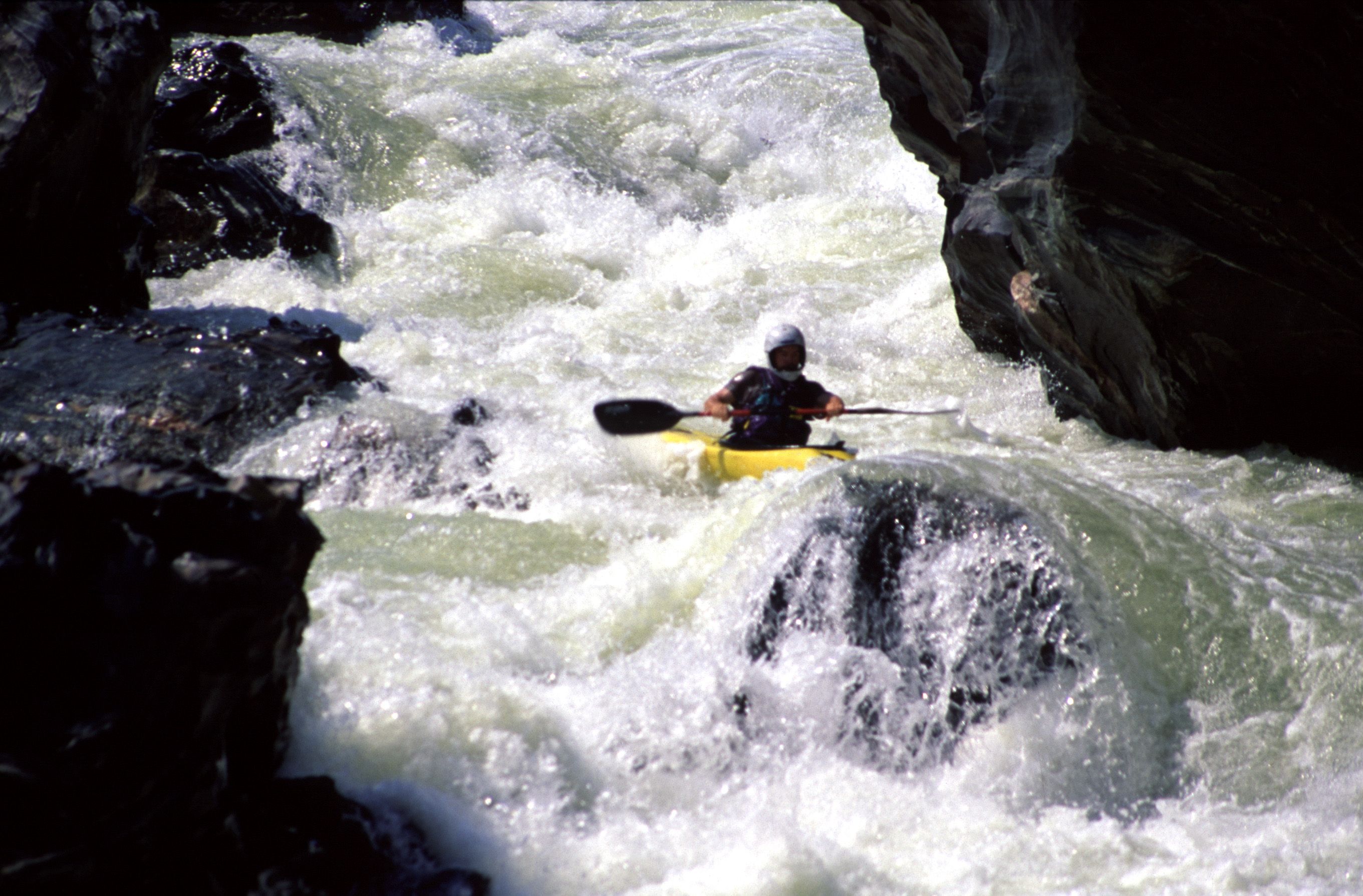
Epupa Falls: The Beginning of Chaos (Johan Radcliffe)
The Crocodile Encounters Intensify
We pushed on, wondering where we were going to camp. Around a corner I spotted a substantial sandbank. “ There it is!” I called, my voice drowned by Johan’s alarm, “ CROCODILE !!” The next few seconds were a blur. At the head of a “V” of reflected waves, I spotted the evil head, racing towards me. I turned to face it and with a huge crank on my paddle, directed my own offensive charge towards it. A split second from impact I swerved away. The croc’s head flashed past my left elbow. A saw-blade of teeth protruding from its mouth glinted briefly, then an image of its yellow eye, imprinted itself vividly in my memory. Over its surprise the massive croc sprung around and lunged at the tail of my boat its jaws “popping” audibly together. Johan and then Matt joined me and for a few brief moments the river seethed with three small craft and one massive crocodile, its head and tail thrashing the water and thumping against our boats. The next second we were all high up on the left bank hurled all forms of abuse at the dark river below, just like baboons surprised by a predator and indignantly protesting from the treetops. Our hearts were still beating like crazy.
For me, a person who can’t even sit through a horror movie at home, this was way past my level of sheer sensory torture. Only the warm glow of a roaring driftwood fire, restored a measure of comfort and security to our confused minds. I fell into a disturbed sleep still shaking my head in disbelief.
The following day after willing ourselves back onto the river we arrived midday at our last rendezvous point. Our report to the crew was this time brief and to the point – gone was the desire to impress them with the horrors we had experienced. Instead we looked at each other silently, bonded now in determination and feeling somewhat distant and disdainful for the crew’s petty problem’s with firewood, food shortage and misread GPS co-ordinates. We had 80 km’s to go to the coast and we were now faced with problem of how to return back again. The only access to the mouth is either through Angola or down the beach of the Skeleton Coast National Park. The former was out of the question for security reasons and the latter a no-no due to environmental concerns. In 1965, Van Riet and Rowe had reached the sea and through sheer luck had managed to hitch a lift on a passing ship. His return trip in 1995 had been more organised and a special Pilatus Porter aircraft had been shipped in from Switzerland to pick them up from the estuary, running shuttles to and from an inland airstrip.
We had tried both these options to no avail. No fishing boats were prepared to fetch us from this remote place and our requests for an air pick-up was dismissed with contempt by all we approached. The presence of a trigger-happy Angolan army unit at Foz do Cunene had a lot to do with this.
Van Riet had said the idea of walking back was lunacy. Henk, son of Louw Schoeman, the Skeleton Coast legend was equally sceptical. Even the local Himbas, the long-adapted desert people of this area, regarded the idea as strange and wouldn’t even hesitate a guess at how long it might take.
In the end we stopped the debate and packed rations and equipment very carefully – each item we took now we had to return with on our backs. There were some hard choices, but after an hour we had a small pile of bare essentials which we fitted into two rucksacks. The third rucksack would be the one to which we planned to attach the raft, deflated and rolled up. The plan was that Johan would join Matt on the raft and I would take my old Rotobat kayak. The Rotobat had been brought along as a spare. It now had be sacrificed. There was little possibility of carrying it and the raft back, so it was going to have to be left behind at the mouth. If we could make the mouth in one day this would give us at least four days rations to walk back on.
Despite an early start our mission to reach the sea in a day was soon well outside the realms of possibility. We encountered four arduous portages, the last of which saw us climb right over a huge granite dome to escape a boulder jam further down where the entire river apparently disappeared through an underground tunnel.
We also encountered crocodiles with even less respect for humans. The first attack confirmed the brilliance of our new defensive measure. With loud “pop” the small buoy we towed behind the raft had disappeared under water. Johan and Matt sprung into action, digging their paddles into the water in a frantic action to distance themselves from the unseen foe. The rope came tight and then slackened. The obviously distasteful buoy resumed its position on the end of the 3 metre line. Had it not been for the buoy the croc would have undoubtedly snatched at the raft instead … with disastrous consequences.
The second attack was from a visibly big croc which charged off the bank and without hesitation. It raced just like a speedboat, its head high out the water, shaking from side to side from the effort of swimming at full speed. I spun around to hide behind the raft, but the croc merely altered its approach, ignoring the raft to snatch at the nose of my kayak. As its jaws clamped onto my plastic boat, Johan landed a fist-sized rock right on its snout. It sprang back in obvious surprise, glared at me and then with an unsuccessful snatch at the buoy it disappeared.
We stopped paddling a minute later to survey the damage. My boat appeared to be fine, the new gouges hardly discernible amongst the existing scratches and dings. Johan’s well-aimed throw had clearly saved me from the inevitable rolling motion that would have followed if the croc had been able to continue its attack.
We slept that night not knowing that the next day would be the most brutal yet. Akin to running back and forth across a busy highway with your eyes closed, is how Matt later described it.
The sun was hardly up when around the first bend Croc # 1 charged us, followed shortly afterwards by Croc’s # 2 and 3. All started short rushes towards us, but the current was fast and in most cases we ended with them trailing twenty metres back in our wake.
Croc #7 was too fast and almost appeared to walk on water. It was right on top of us before we could escape. Its nose and my kayak made contact, before it succumbed to the fusillade of well-aimed stones.
Hence commenced the Crocodile Sprints, from one rapid to the next non-stop for two hours. The full water level on this day had saved us. Had there been a slower current we would not have made it from rapid to rapid without the crocs closing on us.
The stress of looking left, looking right, straining eyes ahead, looking at every ripple, every rock, twice, three times, was draining. Still the crocs managed to surprise us. Like a macabre video game, each corner, each pool was a new screen with new dangers in each. Crocs #12, 13 and 14 came in quick succession, one after another from left, right and then left again. #15 came alongside the raft and Johan lunged at it with his paddle – striking the top of its head.
Number 20 was a monster (read 5m+) and it came off a high bank and shot straight at us. Its bow wave was half a metre high and broke into a tumbling foam pile. This was the most terrifying charge. We cranked for the left corner of the rapid ahead. The croc closed on the rafts tail, surfacing in the rapid to spot us and then surge after us again. There was a short pool and he still came on. We avoided an ambush immediately ahead when another croc joined the fray and we headed left of a small island. As I reached the bottom I turned to see, this new croc, number 21 take the buoy with a huge splash. The raft stopped as if it had hit a brick wall. The croc wrestled the buoy with water splashing wildly. Matthew reached for his knife to cut the rope. He fumbling first with the zip on his pocket and then dropping the knife on the floor of the half-submerged raft. Water mushroomed over the stern and flooded the “anchored” boat. Then the croc let go and they were away.
We stopped for a break. Was this madness ? No words could describe the charge of # 20. The post mortem of the incident was clear. If it had kept its head above water Matt and Johan would have been taken, but we had gained a vital 5 or 6 metres to the next rapid when it had chosen to attack underwater.
“Did you see it surface right where we’d been seconds before”, Matt asked. “ I just saw it’s tail flatten those reeds” replied Johan, “it was thrashing the water, it didn’t even hesitate, it wanted us !” “Did you guys hear my legs knocking against the inside of my kayak” I added, “ its what probably woke the bugger up”.
“Hey,” Matt asked, “ at what point is enough ENOUGH ?” Images of funerals, tears and painful explanations flooded our minds. How do you retrieve a person from the jaws of a monster croc in deep fast flowing water ? And even if possible, what chances would a victim have in this barren wilderness – with medical support at closest a week away. Twenty-one close misses that day alone, the odds were surely against us now. In 1965 Van Riet and Rowe had decided enough was enough at about this point and had set out for Ohopo, 400km away on foot. Four hours later they came to their senses and returned to the river – a decision that no doubt saved their lives.
Number 22 hardly a minute downstream said in no uncertain terms that our own epic was far from over. Head high and teeth protruding it made a spirited attack until our stones and paddles turned it away.
Then there was a long stretch of narrow river, the water flowing in a continuous rapid for more than half an hour. It was better than the pools and crocs above and our spirits recovered. The salty Atlantic air was heavy in the wind. The gorge ended with #23 another absolute monster who almost panicked us totally but which never closed the final gap.
The river then turned north and entered some grey rocky gorges. We passed a nesting colony of white-breasted cormorants. The rapids got bigger.
Croc # 27 closed to within 3m and chased us down two rapids – its head never submerging. We entered a third rapid with metre high haystacks. There was no opportunity to scout or pick a line with the crocodile sticking resolutely to our tails. I battled to keep the kayak upright and straight. Reaching the bottom I saw the raft flip against a rock on the right. They clung on to it for 3 or 4 seconds, as it stood on its side and then they were in the water – with the crocodile. They were swept downstream, trying without success to right the heavily weighted raft. The waves were too big and Johan was separated, he disappeared underwater. Matt righted the stricken raft but failed to pull himself on board - his strength failing him. Where was Johan ? Had the croc taken him – I felt totally numb. What now ?
Then he resurfaced blowing a plume of water from his mouth. As if energised by his “down time” he grabbed the raft and with one motion was back on board – two arms, two legs. My attention switched to Matt, still feebly trying to lever himself out the water. “ Croc” I screamed, not seeing it, but nevertheless giving Matt the motivation to finally get his dangling legs on board. A crocodile ducked its head down just ahead, was that # 27 or another one. We charged over the top of it like two warships planning to ram a submarine.
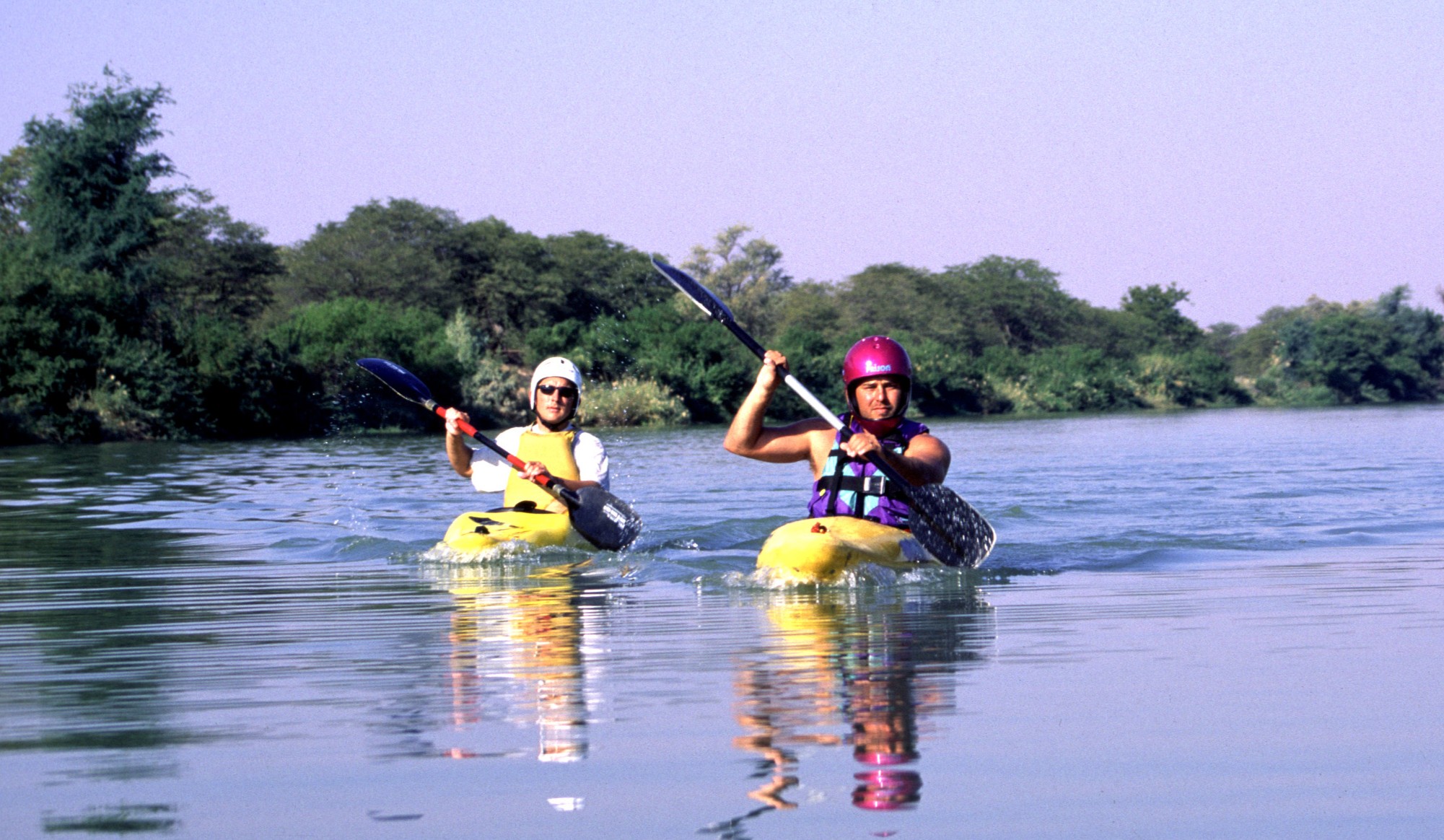
We were shaken and cold – it was 12 o’clock midday. “ Find a place to stop” said Johan, “ we need to take a break !” The river flattened out and in the distance we saw a beach to land on. However, our longing glaze was cut short with the sight of the most ridiculously massive crocodile we had ever seen. For 10 seconds time just stood still and we just stared. The river was dead flat, a headwind almost halted us. The crocodile looked down on us from a sandbank on the right. The left bank was a sheer cliff – no escape here. Was this the end ? The croc stood slowly and trundled its massive frame into the river. It disappeared and the ripples spread across the water towards us. There was no quick burst of speed from us – no plan – no nothing. We were paralysed by fear. We ended up huddled against the cliff face. I gripped a rock and clung on – Matt and Johan held onto me. There we sat clucking expletives like chickens in a closed fowl run with a genet cat. “*uck, *uck, *uck !” we uttered in unison.
But there was no viscous charge, no angry shaking head, no popping jaws. This fact eventually dawned on us and Matt barked “ Let’s get the hell out of his space – NOW !” We pushed off, paddling hard for the distant sandbank. We beached and collapsed. Far upstream the massive crocs head was visible midstream. Then it dawned on us that we had just passed Van Riet’s legendary reptile – the mother of all croc’s, the eater of whales, bull seals and elephants – and not to forget 10-man inflatable rafts courtesy of the 1995 expedition.
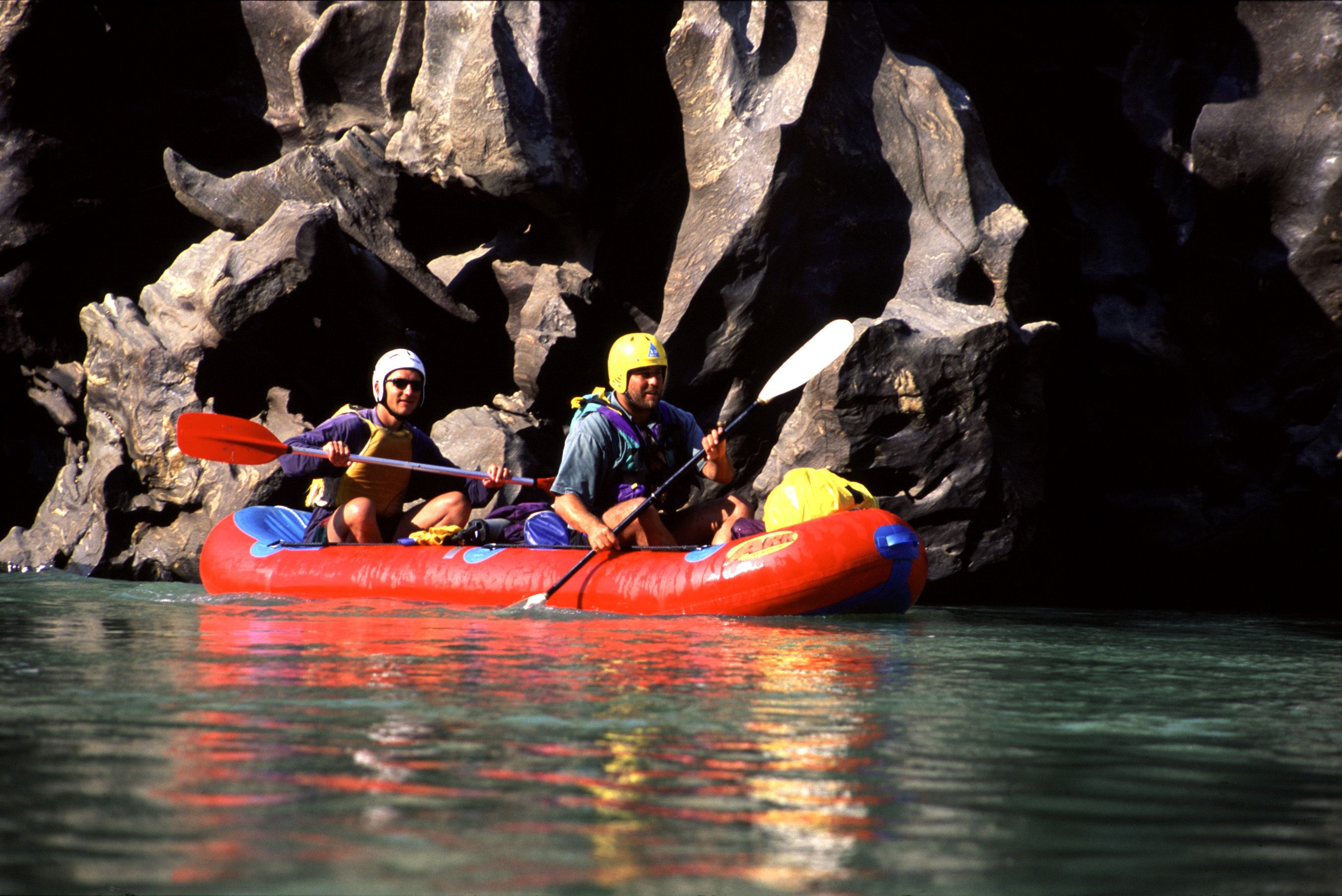
(Matt Pitman and Johan Radcliffe)
The Final Stretch to the Atlantic
The wind howled upstream from the Atlantic – threatening to blow us back upstream. Sand rose like smoke off the lip of the 100m high dunes on the southern bank. The Foz de Cunene soldiers appeared briefly to survey our passing and then retreated back indoors after we ignored their summons.
Then in the distance across a windswept plain of low dunes and reeds we saw the Atlantic. Huge cold waves pounded down on the beach. We had reached the Skeleton Coast and the end of our westward journey. Celebration was brief – a precursory photograph and we turned our backs against the wind, the stinging sand and the glare. Often described as a paradise with giant green turtles, endemic fish species, huge flocks of water birds and abundant game the Kunene River mouth was far the opposite on that bleak afternoon.
Indeed the Namibian side was impossible to walk with dunes sliding straight down to the waters edge. The Angolan side was by stark contrast barren and rocky. The risk of running into an unfriendly Angolan patrol was just a risk we had to take and after deflating the raft and attaching it to an empty rucksack we set out at a brisk pace.

(Darron Raw, Matt Pitman, Johan Radcliffe)
The Journey’s End
For 12 hours the next day we walked like zombies through a landscape of boulders, decaying rock and ancient elephant paths. Finally we were forced back to the Namibian side by the broken country ahead and we went two steps forward one step back across the dunes for kilometre after kilometre. That night we almost drowned in a sea of sand whipped up by the incessant wind. But there was no horror to match the crocodiles and even the sting of blisters, chafe and sunburn was a sweet living sensation compared to the naked, gut-wrenching fear of the previous day’s craziness.
Luck again saw us find our back-up crew who had driven out to meet us deep in the desert sands. This chance meeting in an area of indescribable vastness brought the expedition to a high-spirited end.
On the question of why we did it, we had three long return days to ponder that. We hadn’t gone out to conqueror, nor to claim a “first”. Perhaps the answer lay somewhere in that quest to keep the human spirit alive, a mission that the “Point Break” movie cult most avidly subscribes to. It’s a somewhat anarchic philosophy which dictates an absolute abhorrence for rules, indemnity forms, insurance policies, applications, visas, passports and all those other frustratingly pathetic obstacles which smother most modern day attempts at adventure.
We set out too, to honour the style of early explorers. With little fanfare and minimal support we had invested just enough preparation to be practically sound, but leaving enough unknowns to luck, good fortune and challenge. We went looking for adventure and we found it, now if only I could skin just half of the crocodiles that still torment my sleep, I could surely finance our next escape from the cage.
 Review